To understand Your Autonomization Competencies Profile
Delegation involves empowering another person or team with a goal, role, responsibility, or project. Essentially, knowing how to delegate means knowing how to develop the other person’s competency autonomy.
Delegation follows a logical and natural progression divided into two phases:
Engagement and Autonomization.
Autonomizing means completing the delegation and making the other person autonomous.
To engage or empower, you observe how and where the other person stands and choose your attitudes and stance make the best use of the other person’s leadership. But… how do you make the right choices? In the engagement phase, the Other is only partially ready to invest and commit; you therefore want to create openness, overcome resistance, and increasingly involve the Other. In theautonomization phase, you want to gradually strengthen the Other’s autonomy by knowing when, how, and in what areas to step back to facilitate their assumption of leadership.

You cannot complete a delegation if you don't know to autonomize.
The three fundamental attitudes
Every time you interact, consciously or unconsciously, you choose an attitude and
behaviors to express your position: you choose your " stance ". Your
stance is defined by the attitude or attitudes that make it up. When your stance is appropriate, your
influence is welcome and your interlocutors progress with you, hence the importance of knowing
how to choose whether or not to adopt a stance.
Each isolated behavior inevitably reflects one of the three attitudes. None is good
or bad in itself; each has its advantages and disadvantages, depending on the situation and
on the objectives you share with the Other. Each attitude represents a third of your power
to influence, so it's useful to know when and how to adopt these three attitudes:
D: The Directive attitude : Advising, suggesting, ordering, asking, commenting, etc.
A: The Supportive attitude : Giving confidence, encouraging, highlighting, recognizing, etc.
M: The Mobilizing attitude : Ask questions, make people think, reformulate, encourage ownership, etc.
Combining attitudes
In an interaction, such as a discussion or a meeting, you can use several behaviors and, possibly, more than one attitude. There are eight possible combinations, depending on whether you adopt none, one, two or three attitudes. We call each of these eight combinations a " stance ". Each of the two phases of delegation has the same eight stances.
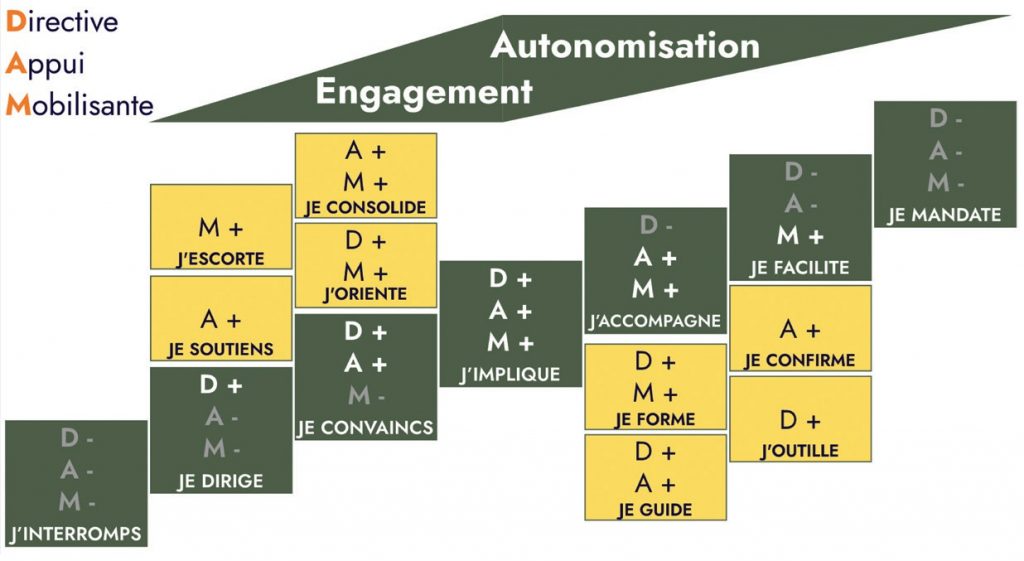
Both phases are carried out in several stages
successive of one, two and three attitudes,
then three, two and one attitude.
In green, there are the typical stances of a
delegation which progresses in a natural
and fluid way. Yellow are the less frequent
stances that correspond to
irregular situations, often more
delicate and emotional. At both poles, you either interrupt delegation when none of the
attitudes is possible, or you mandate, when the Other is autonomous and no intervention
is required on your part.
The questionnaire
Your answers will enable us to draw up a competencies profile illustrating your choices according to the full range of possible stances in each of the two phases of delegation. The
questionnaire includes 16 scenarios:
- 8 are situations specific to the delegation phase
- 8 are situations specific to the autonomization phase
There is one situation per stance, except for the DAM stance "I imply" which is targeted
by two situations, one in each phase.
The Competencies Profile
- Your Autonomization Competencies Profile is not a psychometric tool.
- Your Autonomization Competencies Profile provides an overview of your skills prior to your
participation in an autonomization competencies development program. - It can be useful as part of a development process (coaching, training) or to complement your reading of the book The Art of Autonomizing: A New Perspective on Delegation, Empowerment, and Organizational Intelligence*
(available at www.intercoherence.com).
There are three basic leadership styles in delegation:

Motivational leaders
These leaders are better able
to adjust to the typical
situations of the commitment phase.

Inspiring leaders
These leaders are better able to
adapt to the typical situations
encountered during the autonomization phase.

Versatile leaders
These leaders know how to adjust to
situations encountered in both
phases of delegation.
Each of these three styles is available in three variations:
Sensitive leaders are better able to choose their stances and behaviors in more regular
situations. It is more difficult for them to intervene when the situation is delicate and arouses emotions in the Other or in themselves.
Moderating leaders know better how to choose their stances and behaviors when
emotions experienced in the situation make delegation more delicate. Sometimes these leaders induce an emotional charge that hinders the Other's progress.
Grounding leaders are little affected by the emotional charge of situations. The relevance of their stances and behaviors is not reduced by the emotions experienced in the situation, whether these are their own or those of their interlocutors. This style is the most effective because it is the most flexible.
Would you like to find out more?
Your Detailed Profile ($19.50)
- Your overall effectiveness, your delegation style (strengths and challenges);
- Your detailed efficiency for each phase of delegation, for regular situations and
for delicate situations; - Comments on your answer choices and suggestions for improvement
Your complete profile, personally written by François Pellerin, M.Ps ($99.00)
- Everything in the detailed profile, plus:
- Personalized interpretation on four boards;
- Specific Recommendations